
Fiber pigtails are relatively inexpensive components, but selecting the wrong specification can create expensive installation delays, compatibility issues, and unnecessary maintenance costs. Many procurement problems are not caused by poor product quality—they result from incomplete specifications or incorrect purchasing decisions.
Whether purchasing for an FTTH deployment, GPON network, enterprise cabling system, industrial communication project, or data center, buyers should evaluate compatibility across the entire optical link instead of focusing on individual components.
This guide reviews the most common fiber pigtail purchasing mistakes, explains why they occur, and provides practical recommendations to help buyers prepare more accurate RFQs and avoid unnecessary project risks.
Quick Answer
The most common purchasing mistakes include:
- Choosing the wrong fiber type
- Selecting an incompatible connector
- Mixing APC and UPC connectors
- Ignoring cable diameter
- Ordering incorrect pigtail lengths
- Overlooking installation environments
- Purchasing without complete technical specifications
- Focusing only on price
- Skipping sample verification for large projects
- Ignoring long-term maintenance requirements
Most of these issues can be prevented by verifying the installed fiber, equipment interfaces, and application requirements before placing an order.
Why Fiber Pigtail Purchasing Errors Occur
Fiber pigtails look similar externally, making them easy to underestimate during procurement.
However, a pigtail specification includes multiple technical parameters, including:
- Fiber category
- Connector type
- Connector polish
- Cable diameter
- Fiber length
- Jacket color
- Installation environment
- Packaging method
Missing even one of these items can result in receiving products that are unsuitable for the intended application.
Mistake 1: Choosing the Wrong Fiber Type
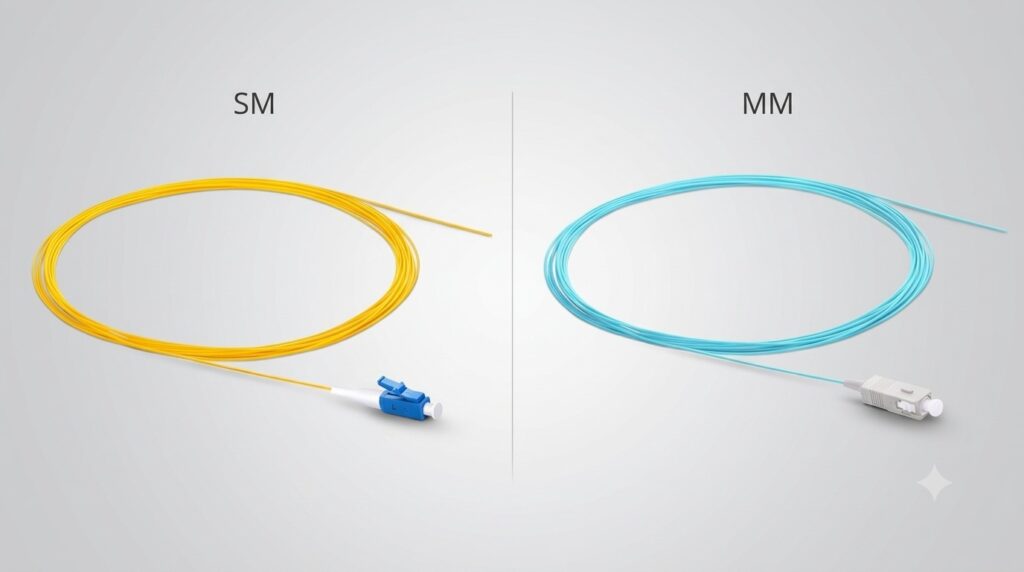
This is one of the most common procurement mistakes.
Some buyers assume that all singlemode or all multimode pigtails are interchangeable.
In reality, different optical networks may use:
- G.652.D
- G.657.A1
- G.657.A2
- OM2
- OM3
- OM4
- OM5
The pigtail should generally match the installed fiber to maintain consistent optical characteristics and simplify future maintenance.
How to Avoid It
Before ordering, verify:
- Existing fiber type
- Network design documents
- Equipment specifications
Never assume the fiber category based solely on connector type or application.
Mistake 2: Selecting the Wrong Connector
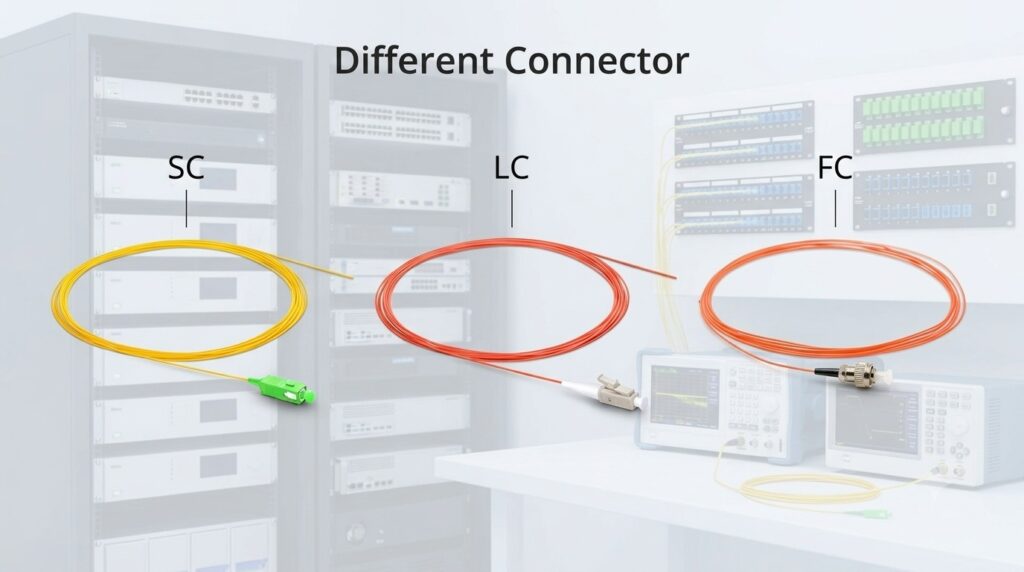
Another common mistake is purchasing the connector that appears to be the most popular instead of the one required by the equipment.
For example:
- Selecting LC connectors for an FTTH project designed around SC interfaces.
- Purchasing SC pigtails for a high-density data center designed for LC connectivity.
The connector must match:
- Optical equipment
- Patch panels
- Adapters
- Existing patch cords
Compatibility should always take priority over personal preference.
Mistake 3: Mixing APC and UPC Connectors
Connector polish is often overlooked during purchasing.
Typical examples include:
- Ordering SC/UPC instead of SC/APC
- Connecting APC patch cords to UPC adapters
- Mixing APC and UPC pigtails within the same optical link
Although the connector housing looks similar, APC and UPC connectors are designed for different optical interfaces.
Using mismatched polish types can increase return loss and degrade network performance.
How to Avoid It
Confirm the connector polish throughout the optical link, including:
- Pigtails
- Adapters
- Patch cords
- Equipment ports
Maintain a consistent APC or UPC standard within each connection.
Mistake 4: Ignoring Cable Diameter
Many buyers focus only on connectors and overlook cable construction.
Common cable diameters include:
- 0.9 mm
- 2.0 mm
- 3.0 mm
A thicker cable is not always a better choice.
For example:
- A 3.0 mm pigtail may not fit efficiently inside a compact splice tray.
- A 0.9 mm pigtail may be preferable for high-density termination boxes.
How to Avoid It
Choose the cable diameter according to:
- Splice tray capacity
- Termination box design
- Cable routing space
- Mechanical protection requirements
The installation environment should determine the cable structure—not assumptions about durability.
Mistake 5: Ordering the Wrong Pigtail Length
Pigtails are available in a variety of standard lengths.
Ordering a length that is too short may make fiber routing difficult.
Ordering one that is excessively long can create unnecessary fiber storage inside the enclosure.
Typical lengths include:
- 1.0 m
- 1.5 m
- 2.0 m
- 3.0 m
The optimal length depends on the enclosure layout and cable routing design rather than a universal standard.
Mistake 6: Ignoring the Installation Environment
The installation environment has a direct impact on which fiber pigtail specification is most appropriate.
For example:
- Indoor telecommunications room
- Outdoor FTTH cabinet
- Industrial production facility
- Data center
- Campus backbone
- Underground splice closure
Each environment may have different requirements for:
- Mechanical protection
- Cable routing
- Space limitations
- Future maintenance
- Environmental exposure
Selecting a pigtail designed for one environment without considering the actual installation conditions may increase installation difficulty and maintenance costs.
How to Avoid It
Before purchasing, confirm:
- Indoor or outdoor installation
- Splice tray or enclosure type
- Available cable management space
- Maintenance accessibility
- Applicable environmental requirements
Mistake 7: Purchasing Based Only on Price
Fiber pigtails are often viewed as standardized products, leading some buyers to compare quotations based only on unit price.
However, products with similar prices may differ in areas such as:
- Factory polishing quality
- Connector dimensional consistency
- Ferrule quality
- Cable flexibility
- Manufacturing consistency
- Factory inspection procedures
For large-scale deployments, consistency between production batches is often more important than achieving the lowest unit price.
How to Avoid It
When evaluating suppliers, consider:
- Product specifications
- Manufacturing consistency
- Quality control procedures
- Inspection documentation
- Delivery capability
- Technical support
The lowest quotation does not always represent the lowest overall project cost.
Mistake 8: Providing Incomplete RFQs
One of the biggest causes of procurement delays is an incomplete inquiry.
For example, an RFQ that simply states:
“Need SC fiber pigtails.”
does not provide enough information for an accurate quotation.
The supplier still needs to clarify:
- Singlemode or multimode?
- Fiber category?
- APC or UPC?
- Cable diameter?
- Pigtail length?
- Quantity?
- Packaging requirements?
- Installation environment?
Multiple rounds of clarification slow down the purchasing process and increase the risk of misunderstandings.
How to Avoid It
Include complete technical specifications in every RFQ whenever possible.
Mistake 9: Skipping Sample Evaluation
For standard products with well-established specifications, samples may not always be necessary.
However, for OEM projects, customized equipment, or large-volume deployments, skipping sample verification can create unnecessary risk.
Samples allow buyers to verify:
- Connector compatibility
- Cable flexibility
- Splice tray fit
- Installation process
- Product labeling
- Packaging
Discovering compatibility issues after mass production is significantly more disruptive than identifying them during sample evaluation.
How to Avoid It
Request samples when:
- Purchasing customized products
- Launching a new project
- Working with a new supplier
- Introducing new equipment
- Confirming OEM specifications
Mistake 10: Ignoring Future Maintenance
Some purchasing decisions focus only on the immediate installation without considering long-term maintenance.
Examples include:
- Using multiple connector standards within the same project
- Mixing different fiber categories without documentation
- Ordering inconsistent pigtail lengths across sites
- Applying different labeling systems for similar installations
These practices may increase inventory complexity and make future maintenance more difficult.
How to Avoid It
Where practical, standardize:
- Fiber category
- Connector type
- Connector polish
- Cable diameter
- Pigtail length
- Labeling conventions
Standardization simplifies inventory management, technician training, spare parts stocking, and future network expansion.
Fiber Pigtail Purchasing Checklist
Before placing an order, verify the following items:
| Item | Verification |
| Fiber Type | G.652.D, G.657 Series, OM3, OM4, OM5 |
| Singlemode or Multimode | Confirm installed cable |
| Connector Type | SC, LC, FC, ST |
| Connector Polish | APC or UPC |
| Cable Diameter | 0.9 mm, 2.0 mm, or 3.0 mm |
| Pigtail Length | Match enclosure layout |
| Installation Environment | Indoor, outdoor, industrial, data center |
| Quantity | Include project spare allowance |
| Packaging | Bulk, tray, or individual |
| Documentation | Datasheet, inspection report, labeling requirements |
Reviewing this checklist before issuing an RFQ can significantly reduce specification errors and improve quotation accuracy.
Expert Recommendation
Most fiber pigtail purchasing mistakes are preventable.
Rather than selecting products based on appearance or previous purchasing habits, buyers should follow a structured evaluation process:
- Confirm the installed fiber type.
- Verify the equipment connector interface.
- Select the correct APC or UPC polish.
- Choose a cable diameter suitable for the enclosure.
- Consider installation conditions and future maintenance.
- Provide complete specifications when requesting quotations.
For larger projects, establishing standardized pigtail specifications across similar network deployments can simplify procurement, improve installation consistency, and reduce long-term operational costs.
FAQ
What is the most common purchasing mistake for fiber pigtails?
Selecting the wrong fiber type or connector is among the most common mistakes. Always verify the installed fiber and equipment interfaces before ordering.
Can I use any SC pigtail in an FTTH project?
No. In addition to the SC connector, you must confirm the correct fiber type (such as G.657.A2) and the required polish (typically APC for GPON and XGS-PON networks).
Why is connector polish important?
APC and UPC connectors have different end-face geometries and are designed for different applications. Mixing them within the same optical connection can increase return loss and reduce overall link performance.
Is a 3.0 mm pigtail better than a 0.9 mm pigtail?
Not necessarily.
A 3.0 mm pigtail provides greater mechanical protection, while a 0.9 mm pigtail is often easier to route within splice trays and compact termination boxes. The appropriate choice depends on the installation environment.
Should I always request samples before placing an order?
For standard products, samples may not always be required. However, they are recommended for OEM projects, customized specifications, or large-volume purchases to verify compatibility before mass production.
How can I make my RFQ more accurate?
Include the fiber type, connector, connector polish, cable diameter, pigtail length, installation environment, quantity, packaging requirements, and any documentation needed. The more complete the specification, the more accurate the quotation will be.
Should I standardize pigtail specifications across projects?
Where practical, yes. Standardization can simplify purchasing, reduce spare part inventory, improve maintenance efficiency, and make technician training more consistent.
Can price alone determine which fiber pigtail I should buy?
No.
Price should be considered together with product specifications, manufacturing consistency, quality control, documentation, and supplier support. The lowest purchase price does not always result in the lowest total project cost.
Related Guides
- Which Fiber Pigtail Is Best for Fusion Splicing Projects?
- How to Choose Between Singlemode and Multimode Fiber Pigtails?
- How to Choose the Right Connector for Fiber Pigtails?
- How to Evaluate Fiber Pigtail Quality Before Buying
- How to Choose Between APC and UPC Connectors?
Key Takeaways
- Most fiber pigtail purchasing mistakes result from incomplete specifications rather than product defects.
- Always verify the fiber type, connector, connector polish, cable diameter, and installation environment before placing an order.
- Avoid selecting products based solely on price or popularity; compatibility with the existing network is the primary consideration.
- For customized or high-volume projects, sample evaluation can identify potential compatibility issues before mass production.
- Standardizing pigtail specifications across similar projects helps simplify procurement, inventory management, and long-term maintenance.
- A detailed RFQ enables suppliers to provide faster, more accurate quotations and reduces the risk of delays caused by specification errors.
Keywords
fiber pigtail purchasing mistakes, fiber pigtail buying guide, common fiber pigtail errors, fiber pigtail specification, SC fiber pigtail, LC fiber pigtail, singlemode fiber pigtail, multimode fiber pigtail, APC vs UPC pigtail, FTTH fiber pigtail, GPON fiber pigtail, XGS-PON pigtail, fusion splice pigtail, fiber optic pigtail selection, optical fiber pigtail, enterprise fiber pigtail, data center fiber pigtail, industrial fiber pigtail, fiber pigtail quality, fiber pigtail RFQ


 Get Your Best Price Now!