
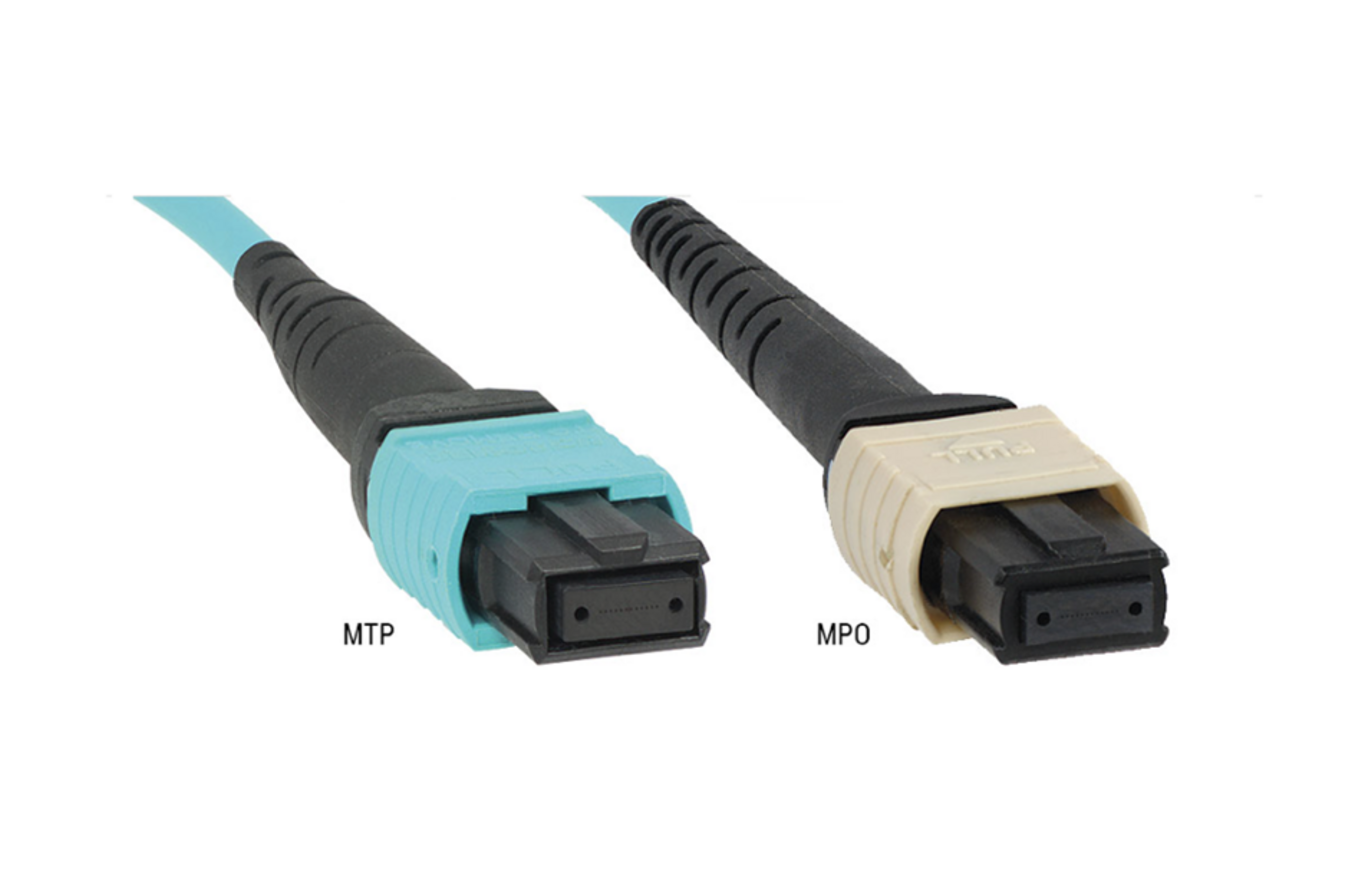
In today’s bandwidth-hungry world, fiber networks must scale rapidly while maintaining low loss, high density, and future-proof flexibility. As a result, MPO (Multi-Fiber Push-On) and MTP® (Mechanical Transfer Push-On)connectors have become essential components in data centers, 5G infrastructures, and enterprise backbone networks. But while they look similar on the surface, choosing the right one could directly affect your system’s performance, scalability, and maintenance cost.
In this guide, we’ll break down the differences between MPO and MTP connectors, discuss their technical performance, real-world applications, and help you make the best choice for your project.
What Are MPO and MTP® Connectors?
🔹 MPO Connector: The Industry Standard
- Developed and standardized by IEC-61754-7 and TIA-604-5 (FOCIS 5).
- Supports 12, 24, 48, up to 72 fibers in a single rectangular ferrule.
- Commonly used in parallel optics, fiber trunk cables, and high-density patch panels.
🔹 MTP® Connector: The Premium Variant
- A trademarked product from US Conec, MTP® is an enhanced MPO connector.
- Offers tighter tolerances, removable housing, improved insertion loss, and better mechanical performance.
- Fully compliant with MPO standards and backward compatible.
🧠 Quick Tip: All MTP® connectors are MPOs, but not all MPOs are MTP®. Think of MTP as the “high-end version” of MPO.
Key Differences: MPO vs MTP®
| Feature | MPO | MTP® (US Conec) |
| Manufacturer | Multiple vendors | Only by US Conec |
| Performance Consistency | Varies by manufacturer | Precision engineered |
| Ferrule Material | Standard thermoplastic | Polyetherimide with enhanced durability |
| Removable Housing | Not always | Yes (enables field tuning) |
| Insertion Loss | Higher (0.5 dB typical) | Lower (0.2–0.35 dB typical) |
| Return Loss | >20 dB | >60 dB (for APC) |
| Alignment Design | Molded-in | Centered guide pins, tighter tolerance |
| Cleaning/Polishing Quality | Varies | Factory-optimized and consistent |
When Should You Choose MPO?
✅ Best for:
- Cost-sensitive projects
- Short links or lower-performance applications
- General backbone or horizontal cabling
📌 Caution:
- Check manufacturer quality and polish consistency
- Not all MPO connectors are created equal
When Should You Choose MTP®?
✅ Best for:
- High-performance data centers
- 40G/100G/400G transmission
- Backbone trunks requiring ultra-low loss
🎯 Why It Matters:
- Lower loss enables longer reach and higher density
- Swappable housing improves troubleshooting and maintenance
- Ideal for next-gen 5G base stations and hyperscale networks
Real-World Case: 5G Base Station Deployment
In a recent FTTA deployment in the Middle East, a regional telecom operator chose MTP-LC harnesses over standard MPO, citing:
- 32% reduction in insertion loss failures
- Easier cable management due to removable housing
- Faster on-site testing and connector replacement
💡 The result? Installation time dropped by 27% compared to previous MPO installations.
Common Buyer Mistakes to Avoid
🚫 Mistake #1: Confusing compatibility
Not all MPO connectors from different suppliers are equal in polish angle and performance. Always ask for IL/RL test reports.
🚫 Mistake #2: Choosing by price alone
Cheap MPO connectors often lead to high rework costs due to poor polishing or guide-pin misalignment.
🚫 Mistake #3: Overlooking cleaning tools
Both MTP and MPO require specialized cleaners (e.g., IBC/MPO cleaning pens) to ensure performance.
Recommended MPO/MTP Solutions
🔗 Pre-Terminated MPO Patch Cords – HOLIGHT
🔗 MTP-LC Fanout Cables – Customizable Solutions
Explore our no-MOQ, fast delivery, and fully customizable options trusted by distributors and installers in Europe and USA.
Industry Standards & Testing
According to the Fiber Broadband Association and US Conec, high-density MTP® links are expected to replace most 12F MPO in data centers by 2026 due to superior performance under high-speed demand.
📖 Learn more at:
🔵 Fiber Broadband Association
🔵 US Conec Official Site
FAQ
Q1: Is MTP backward compatible with MPO systems?
Yes, MTP® connectors are fully compatible with standard MPO adapters and cassettes.
Q2: Can I mix MTP and MPO in the same link?
Yes, but be aware of insertion loss variance between different brands.
Q3: Are MTP cables worth the higher cost?
If your network demands high performance, reduced downtime, and future scaling, absolutely yes.
Q4: Are there MPO/APC versions available?
Yes, both MPO and MTP come in UPC and APC polishing types for high-performance links.
Q5: Which fiber counts are most common?
12F and 24F are standard, but HOLIGHT also supports 8F, 16F, 48F, and 72F on request.
Q6: Do I need special testers for MTP/MPO links?
Yes. Use multi-fiber testers or visual inspection tools compatible with MPO interfaces.
Keyword Summary
MPO connector, MTP connector, MPO vs MTP, fiber optic connector types, MTP vs MPO difference, multi-fiber connector, high-density patch cord, MTP-LC fanout, MPO cleaning tool, 5G MPO harness, MPO loss value



 Get Your Best Price Now!